How I work a report day
Tore Vaaland · 16 October 2026
I follow a small number of companies. When one reports, I read the new material alongside what I already know and the questions I'm still waiting to have answered. This is how I worked through Napatech's Q2 2026 report on 25 August, using tworavens.no, the app I built for my own research. It doesn't mean it's how everyone should do it, but it's a place to start. I own Napatech shares, so read it with that in mind.
Getting the report
First of all, I download the report when it's available. The fastest way is often Newsweb, where the report is an attachment to the official news. For Napatech there was also the Q2 presentation. I read both myself and give them to tworavens.no and external AIs. Each of them reads it a little differently, so I get more eyes on it.
The app pulls the figures out of the financial statements, and the written part too: risks, strategy, management's commentary, and the customers and partners the report names. From a call transcript it also pulls out the questions and answers. Every finding links to the exact passage it came from, so I can click through and check it against the source. A second AI pass checks that the passage really says what the finding claims, and findings the AI approves are usable straight away. When I review one myself, my approval or rejection overrides the AI. How all of that works is a post of its own.
The questions for the call
I register for the earnings call, then find the questions I've prepared. Some come from reading the new report, with help from the app and external AI. Others are questions the last report left open. I keep them in the Q&A and IR section of the app.
I try to limit myself to three questions, the ones I deem most important, for whatever reason, at the time.
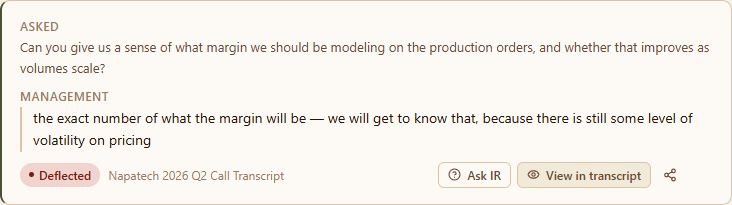
For Q2 I only asked one. My other questions were answered in the report or asked by others. CFO Klaus Skovrup read mine out during the Q&A part of the presentation:
You say in AI infrastructure, products come with a lower gross margin. Can you give us a sense of what margin we should be modeling on the production orders, and whether that improves as volumes scale?
CEO Kartik Srinivasan couldn't give an exact number yet. Memory and component pricing were still moving around, and they would come back with guidance as volumes and visibility improved. That question stays open for Q3.
I asked it because I think the margins will have to drop when the products go from development to production. That is my theory, at least. Peers don't have margins of 65% or more on production.
Silicom, which also sells SmartNICs, had a gross margin of 30.6% in 2025. Arista's gross margin fell from 65.6% to 63.4% in a year, which Arista put down to its mix of customers. Napatech's own guidance for 2026 is 60 to 70%, against 67% in Q2.
Napatech's own numbers don't settle it yet. Core Infrastructure ran at about 70% gross margin in the first half and the whole company at 68%, but AI was still a small part of revenue.
The call and the transcript
I listen to the call and record it if I'm able. Otherwise I wait for the recording to be released.
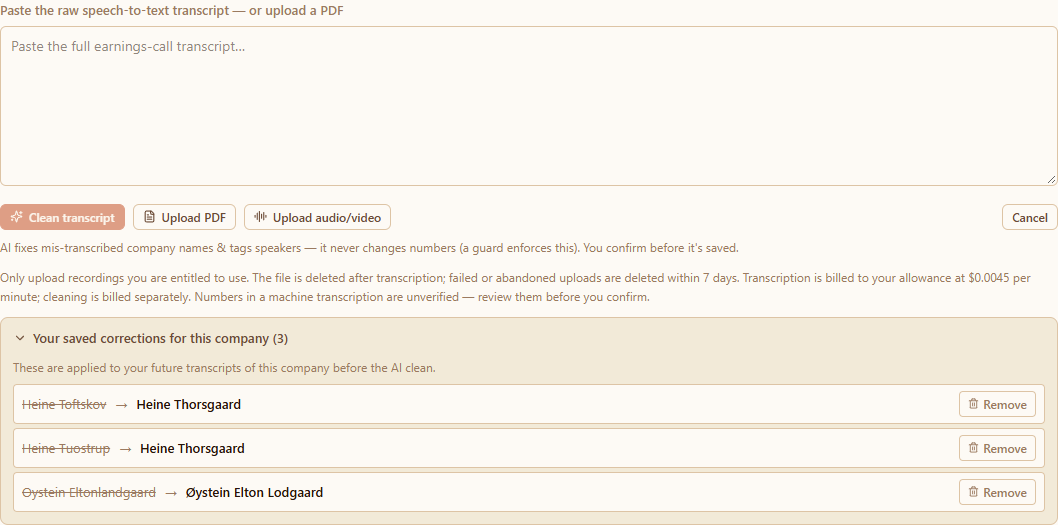
Napatech doesn't publish a call transcript, so for Q2 I made it myself. I used the free version of Speechmatics, then AI to clean up the transcript. Names and terms needed checking before I could use it.
Making the transcript took no more than ten minutes from start to finish. I already had the tools and a dictionary to correct names and terms from.
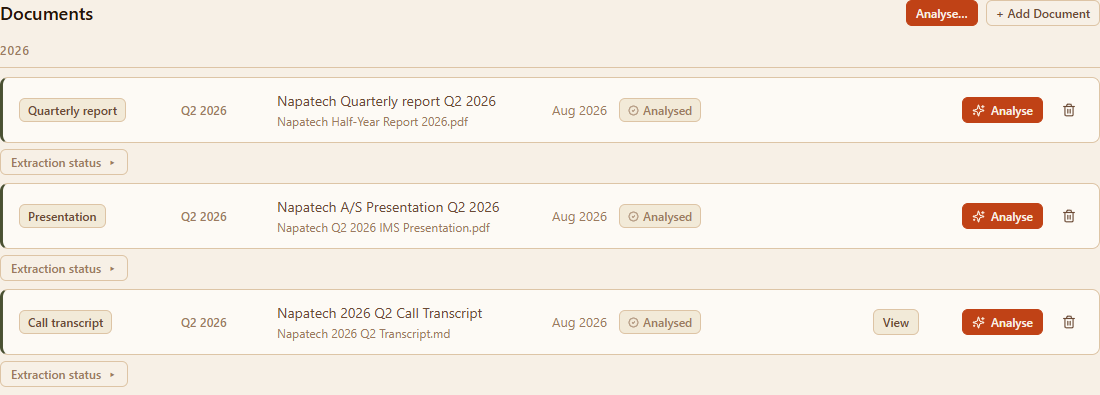
I uploaded it alongside the report and presentation, then started looking at the analysis across the day's documents. If the company releases other material, that goes in too.
The news around the report
I keep an eye on the news coming out and add it to the record. Analyst reactions go in as well, including changes to their price targets.
There was already a lot going on before Q2. On 13 August, Napatech announced a follow-on order for around 2,000 units, with shipments expected to start in Q1 2027. The next day, Finansavisen reported that ABG Sundal Collier had raised its target from NOK 40 to 85.
On report day, the news was more mixed. Finansavisen covered the lower unit guidance: 7,700 to 9,700 units, down from 8,700 to 10,700. Revenue guidance stayed at DKK 200 to 240 million. The company's explanation included a move towards higher-priced products, but it also expected fewer AI Infrastructure units in 2026 than originally planned.
On 26 August, the day after the report, ABG Sundal Collier raised its target again, from NOK 85 to 87, and kept its buy recommendation.
In figures from 28 August, the analysts' average target was NOK 68, against the previous day's close of 40.70.
I also added a warrant exercise notice. I use the app and external AIs to look at reactions from analysts and forums, then enter them as News or Notes.
The event threads are where I follow one story across several reports. Before Q2, I was waiting for conversion numbers: of the 27 design wins from 2025, how many had become production revenue? The historical conversion rate for the 2024 cohort was also missing.
The follow-on order was evidence of progress, but it didn't give me those conversion numbers. Q2 didn't close those questions either. I keep them alongside the new evidence in the design-win thread.
Napatech · Design-win thread The design-win pipeline, Q2 2022 to Q3 2026 Design wins, production orders and the questions still open, each with its source. Read the thread and its sources →What I decide, and what I don't
I don't really make up my mind on that first day. I do decide whether my main thesis still holds and whether to stay invested. Then I keep working through the material.
The synthesis I ran on 26 August put the good and the bad side by side. Q2 revenue was DKK 48.1 million, up 52% year on year, with gross margin at 67%. Free cash flow was minus DKK 35.3 million. Inventory was DKK 80.6 million. Napatech put the weak cash flow down to invoicing late in the quarter and building inventory for the demand it expects in the second half.
No single figure worries me. It's more the macro worries, and the doom-and-gloom sayers all over the place. I try to stick to what I think.
I tend to add new thesis points, the short statements my case for owning the stock rests on, based on the new information. The day after the report I added seven AI-suggested points. I approved two then and came back to the other five on 1 September. The first two were about cash being tied up in working capital, and about AI design wins starting to convert while near-term AI unit expectations fell.
I didn't like the Q2 news, especially the lower number of AI units this year. Then I reminded myself of the timing. I expect Napatech's AI business to move into volume production in 2027, and the two orders from d-Matrix, the AI inference customer, are just the start, as I see it. A lot comes together that year: design wins converting, more volume from d-Matrix, and a tier-one OEM server customer that was delayed. On the Q2 call, the CEO put that delay down to management changes at the customer. I'm simplifying, but that's how I see it. Meanwhile the Core Infrastructure business, the older part of Napatech, grew 65% in the first half, to USD 12.8 million.
So I'm staying invested. That decision isn't based on the Q2 report alone; other factors matter as well.
My main thesis is that Napatech will become important to the build-out of AI in datacenters around the world. I think it will.
My views come from a mix of my own thoughts on what I read and what we know to be true from the reports. I also use the wider sector news and the macro situation, how people actually use AI systems, and where I think that is going in 2027, 2030 or 2040.
There is a good dose of speculation in it too. I need to keep checking it.
Over the next few days I keep gathering questions from the app and from my own reading. I ask the data questions through Huginn chat, which answers from my record, and read the analysis of the new material.
The checklist
- Download the report when it's available; check Newsweb for the attachment.
- Read it, and give it to tworavens.no and your other AIs.
- Register for the earnings call and find your prepared questions in Q&A and IR.
- Use the current report and your open questions to pick what matters most. I aim for three, fewer if they've already been answered.
- Listen to the call and record it if possible, or wait for the released recording.
- Make a transcript if needed and check the names and terms. Bring it into the record and run analysis across the report, presentation and any other documents.
- Monitor and add news through the day and update analyst reactions, including price targets.
- Update your thesis points and the event threads.
- Decide whether the main thesis still holds, then keep gathering questions for a few days.